I spent some time this afternoon transferring old files from creaking hard drives into my laptop, out of curiosity to see what I could recover. Thinking back on my history with photography, I could bring to mind specific photographs that I had taken in 2007 to 2009, when I was around 14 to 16, first trying out photography with a hand-me-down Nikon. I all but knew that all the files were lost back in 2011–2012 when I shifted from a Mac to a Windows laptop and just failed to tend to the files left on the Mac until – if memory serves – the laptop just died one day. Still, one could hold out hope.
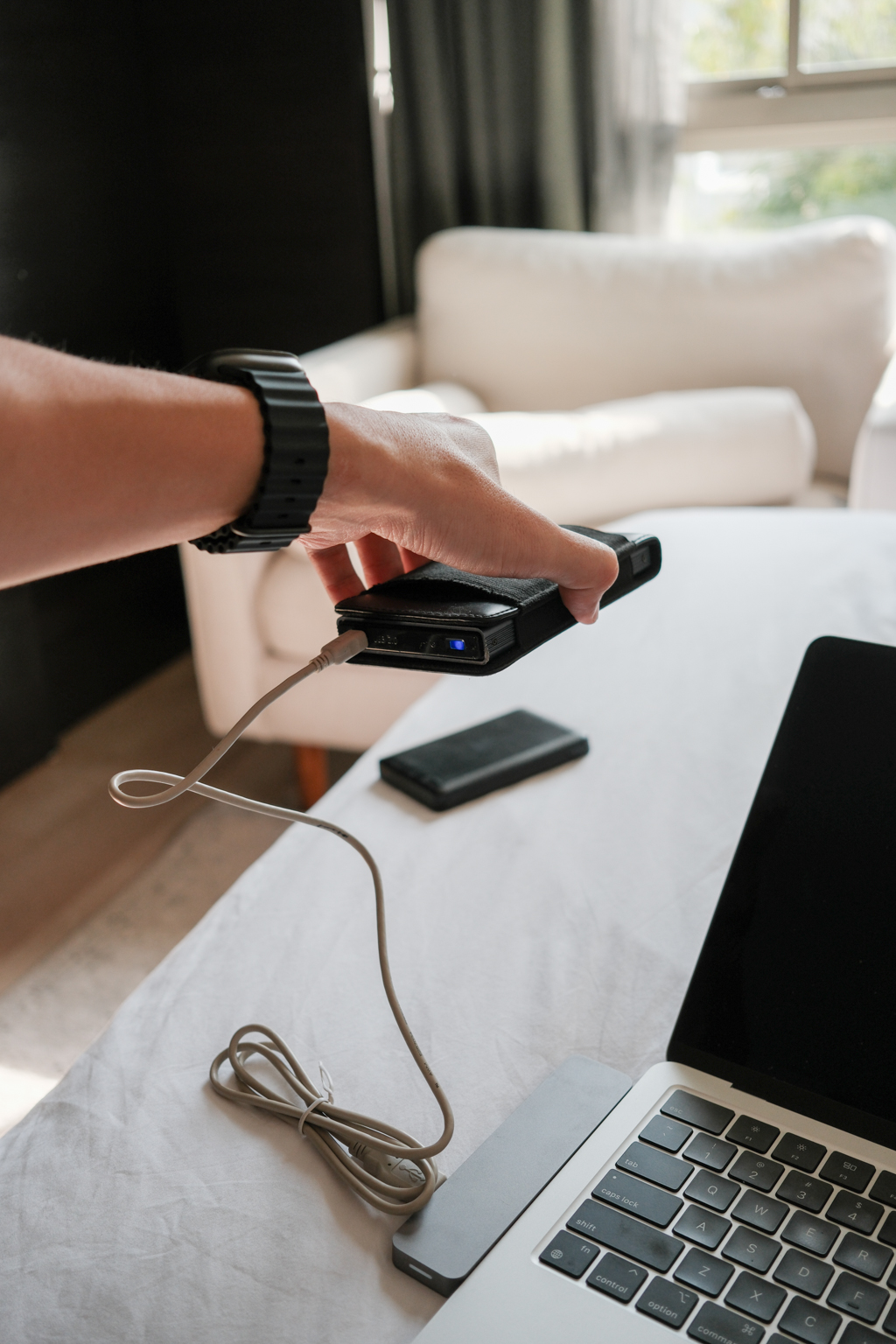
I scrounged around for a suitable cable and plugged in the first hard drive. A blue light lit and the disk whirred. But my laptop couldn’t read it. I was about to give up when I pressed down on my bed (this whole operation was done on my sheets) and the hard drive was angled. That seemed to do the trick. I went into the drive and saw only two folders: ANIME and work. The ANIME folder is a separate story. I went through work and saw only some of the more polished pieces done in 2010 onwards. None of the earlier photographs that I could recall (I was hoping especially to find the photographs from a trip to Italy my parents took us on in middle school). Disappointed, I transferred the files onto my laptop just for good measure.
The hard drive had to be cajoled to give up its bytes by holding it up, letting gravity work on the cable.
I half suspect that I had made the conscious choice only to keep these files. The broken promise of memory once offered by those photographs left a bit of an ache.
On to the next one. There was more promise here. A Pictures folder with a custom icon – I recall having done this on my old MacBook Pro. Maybe this would contain the lost files!
At first glance, it contained some less polished work, but none of the photographs that I wanted to see. And, to be frank, a lot of it was just disappointing – I had taken a bit of a “conceptual” turn in my later teenage years when I should have been practicing technique. It was, I think, ultimately a good thing that I did not try to pursue an art education – I would have been insufferable!
The best lead I had was a folder with the promising name iPhoto Library. Created 30 April 2007, modified 21 December 2010. I used Photos to import this folder and while there were some photographs in there, so much more was missing. Or so I thought, until I searched around for a tool that could extract image files from some of these databases. Running the folder through the program, it was able to retrieve thousands of thumbnails, tiny, unusable images, but enough to give me a sense of what was there before. Breadcrumbs for my memory. Here they were, some of my early photographs! Many were terrible, some were passable, but what was important was that they had been taken. Still, it was probably a good thing that they were so tiny – a mercy not to be confronted too forcefully with the folly of youth.
It was good to clear out these hard drives once and for all. But the sense that I was left with, at the end, was largely that of disappointment. These were many wasted years, in between, from my early enthusiasm in the late 2000s, to the years of conceptual, high-brow intellectualism that would distract me from craft and purpose. A decision to pursue a more prosaic degree – itself valuable and an experience I would not trade away – eventually relegated photography to a hobby, and not even one actively pursued at that. Wasted time? In one sense. But we have the life we have, and there is much for me to be grateful for.
After a morning of errands, I took myself to the Central Library, to browse otherwise inaccessible photography books. I was reminded, as I always am upon setting foot in one of our many public libraries, that these are among the most important public works. And, even better, these really are quite well done here in Singapore. Certainly not inevitable, and therefore all the more remarkable.
An old woman, curly gray hair, face puckered, was hunched over (a permanent posture?) taking notes from one of many books, her selection walling her in.
I find myself facing a rather imposing set of shelves. It is quiet. Only the distant rustling of paper, the occasional steps, and the hum of the warm lights. In the middle of the busy city, just me and this row of books.
I grazed the shelves, my attention drawn here to a striking title, there to a vaguely familiar name. I judge books by their covers. Some, I note down quickly in my phone.
Zero Mostel reads a book is a curious little, well, book. The publishers readily admit to having published it “for the fun of it”. The introduction describes the photographs as “eloquent” – surprised, I agree.
Walker Evans’s Many Are Called is accompanied by some fine writing. The idea of a secret camera gives me pause. Later, as I walk around, it strikes me that the social compact surrounding being photographed in public may well be city-specific. Here, I feel uneasy – I try to take a snap of someone as part of a larger composition, but feel his eyes on me (I confirm this later) and walk away, wondering if I’d pretend not to speak English if he confronted me.
I sit with a massive retrospective of Edwin Smith, an architectural and “topographical” photographer. He was critical of the shift to colour, claiming that light and shadow were antithetical to colour. Some of his photographs seem bland by today’s standards. In fact, taken out of context, many photographs by these pioneers may be passed over as rather boring, almost rudimentary, the fare of a beginner with his first camera. Perhaps because we do not know how hard it was to take these photos, in our age of ubiquitous megapixels and automatic everything. I try to resist this prejudice, to retrain my eyes. I think it works, a little. The thought recurs as I step through a few other books of earlier photography.
I savour Atget’s description of his photographs as “documents”. The photographer as technician, custodian. Edwin Smith had tried to identify as an artist for most of his life, only accepting (resigning himself to?) the title of “photographer” later in life.
I go through a few more in quick succession. Some autobiographical, some reportage, some street. Much of the meaning behind these books of photographs lies in their subjects – these books demonstrate that at least one purpose of photography is to elicit the truth of the subject, to disclose it to another who is not present. They serve as a record, a representation, a memorial, a correction, a testimony, a witness.
I think about the inevitable link between technique and meaning. I wonder what camera Andreas Gursky uses.
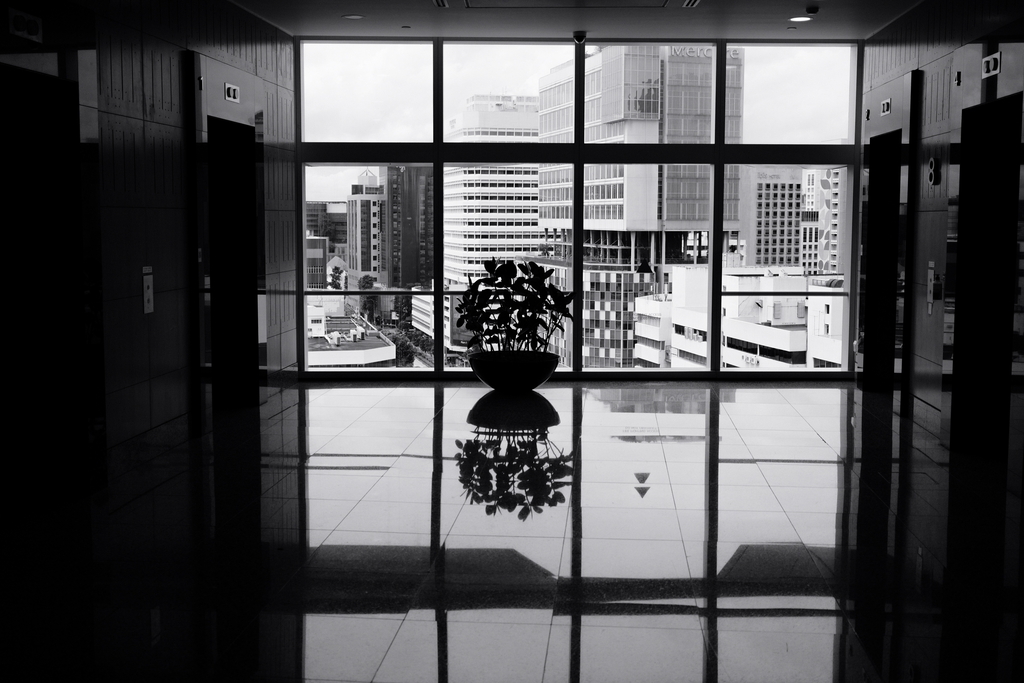
I feel the urge to photograph. I leave, and observe the light bounding off polished tiles.
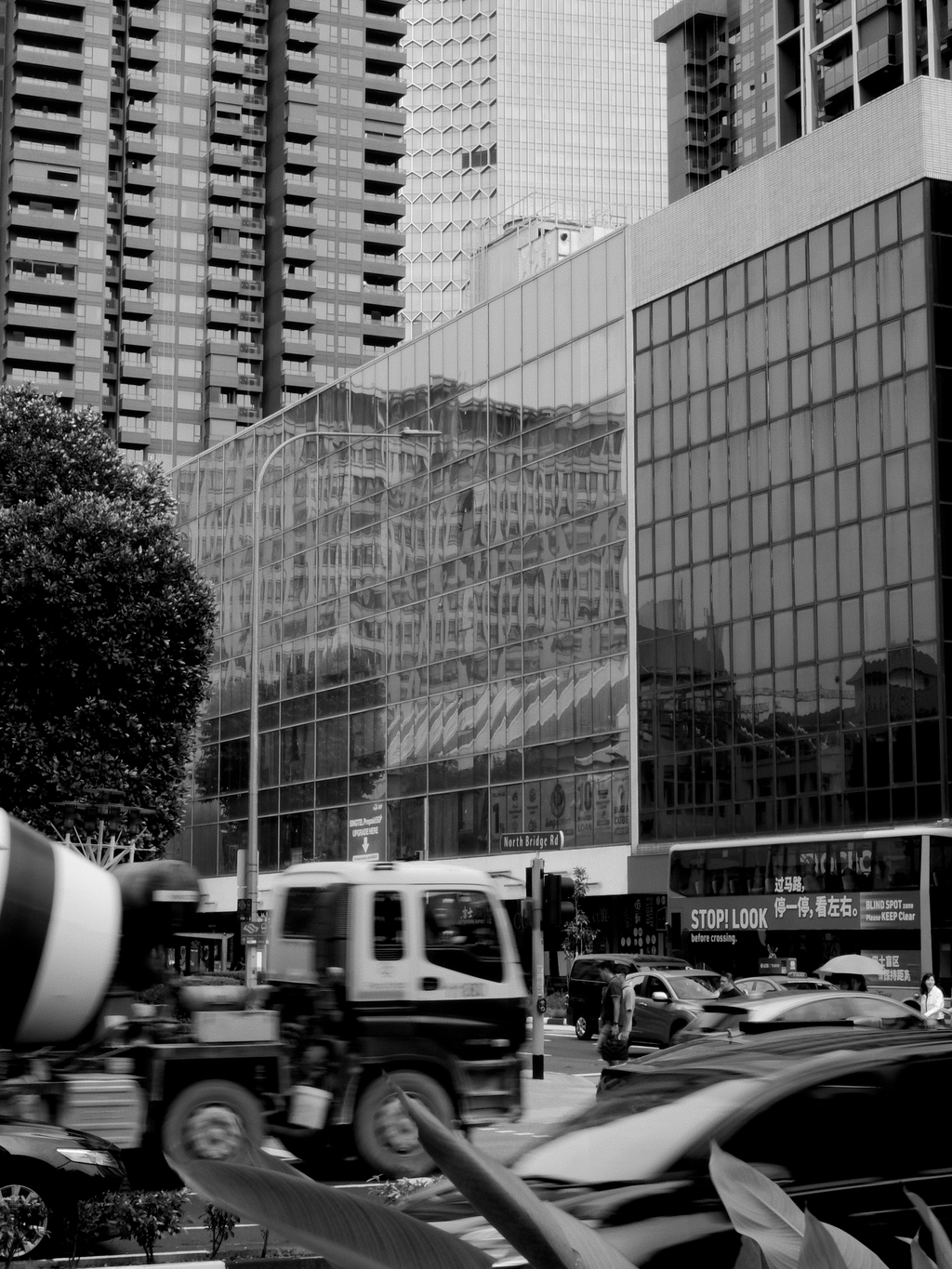
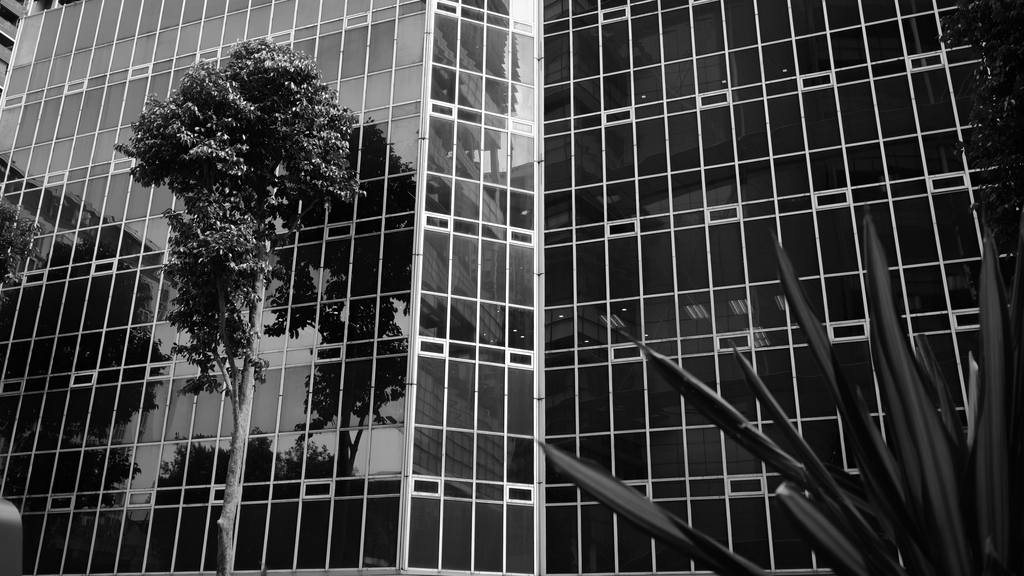
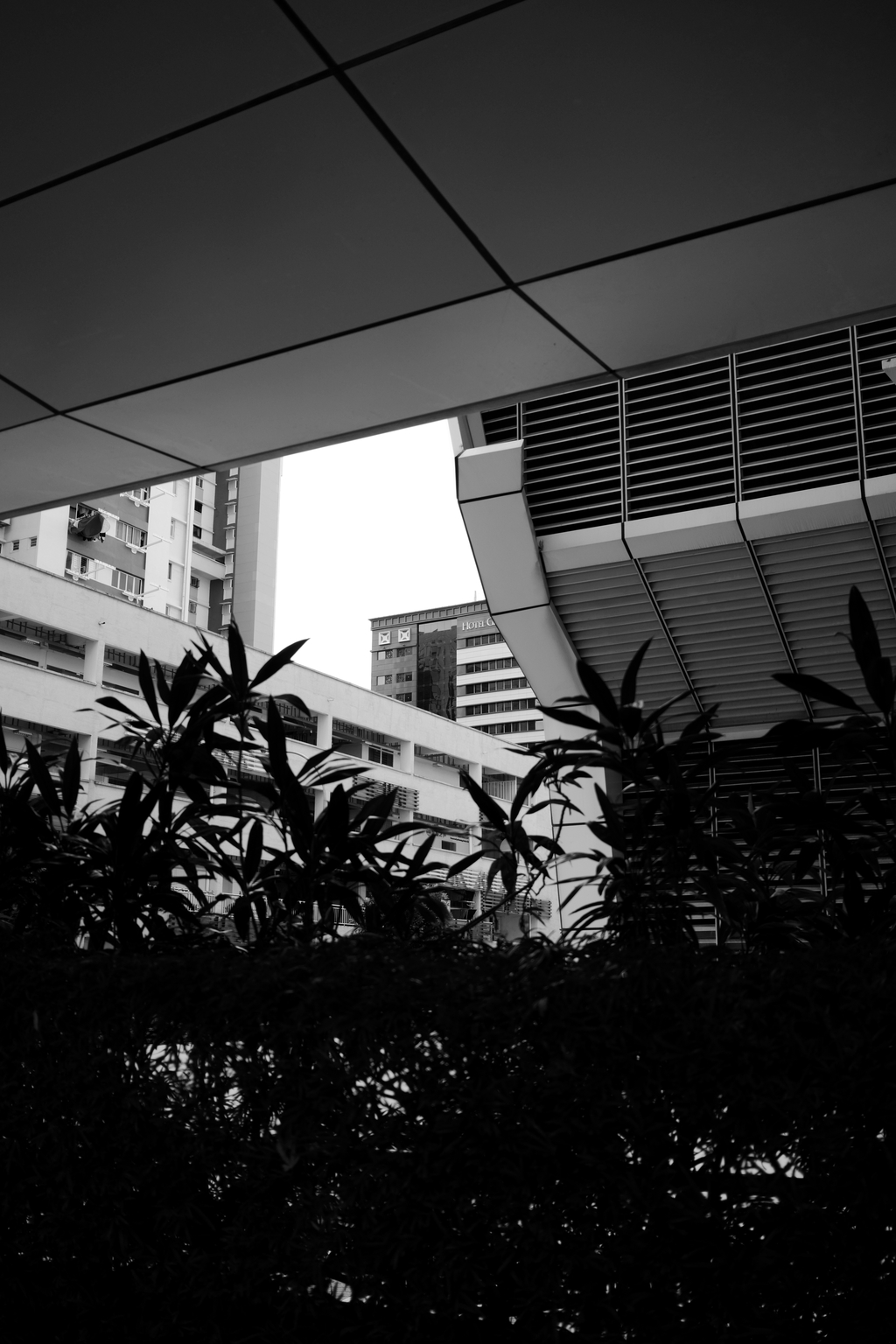
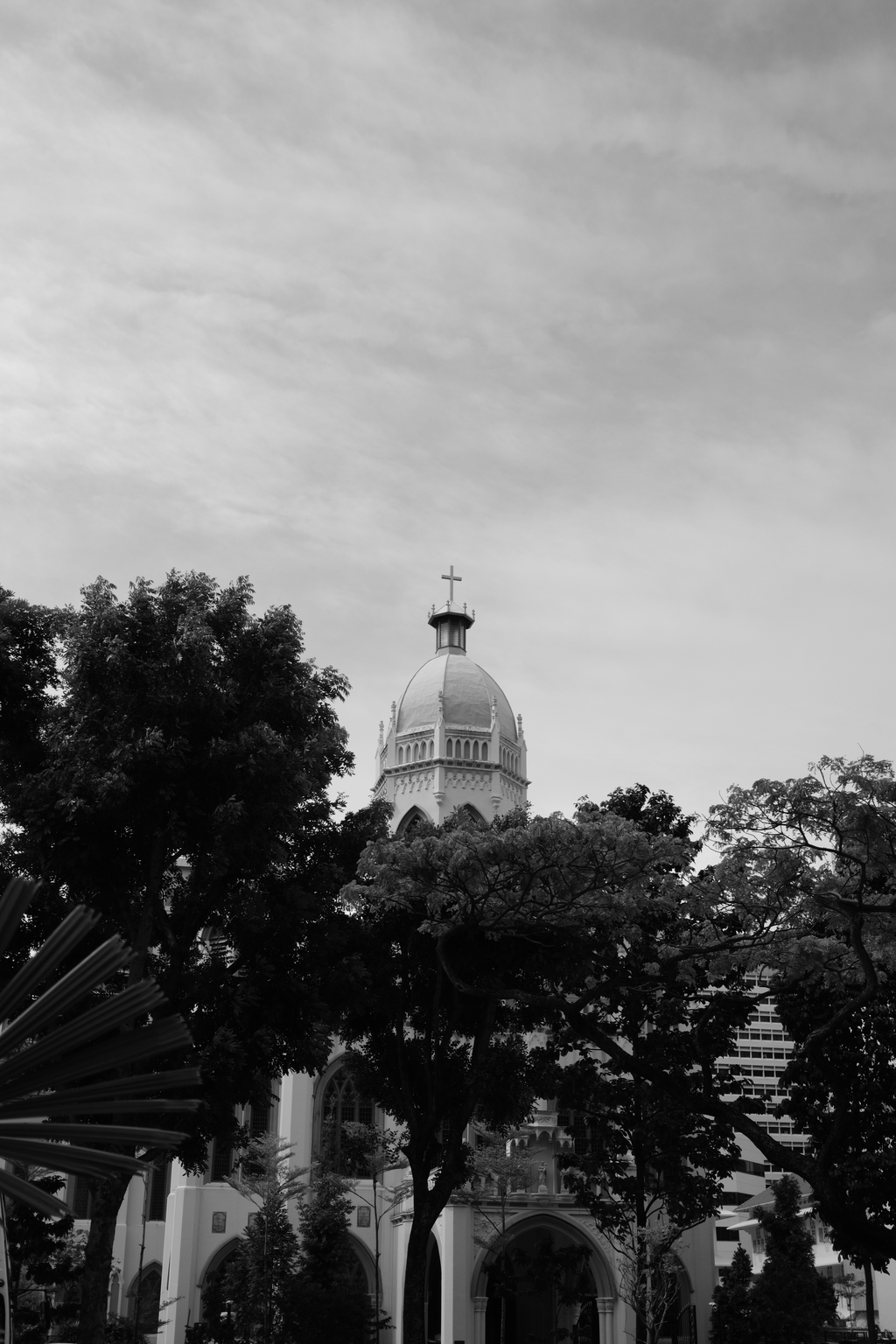
Downstairs, I start to walk the circumference of the building. I’m not quite warmed up, and the shots come slow. I stick with monochrome, in homage to Edwin Smith.
The pickings are slim today, but as an exercise just after the library, I cannot complain – to expose one’s sensibilities to other work, and then to try to exercise the mind’s eye.
Back to work tomorrow.
❏
12:50 I sat outside, near the decommissioned yellow cable car, next to a group of colleagues over lunch. How many of such similar groups peppered the eateries across the island, with repeated dynamics, talking about travel and holidays, past and planned? An escape. The typical question: “So, do you have any travel plans?” And the anecdotes roll.
13:10 Zero Mostel Reads a Book. “The result, we think, is eloquent and amusing. We hope you like it. ... Published for the fun of it by The New York Times and dedicated to the American booksellers.”
Since the days of MySpace and Xanga, I have always admired those who had well-maintained online spaces. In recent months, I have been visiting and revisiting a numberofblogs and websites that made me want to blog. It really is quite shallow – something about the design of those blogs (not to mention the content) elicited a reaction: “I want to make something like that too.”
With the year coming to a close and a few days of leave (what a difference that makes, I now realise!), I decided to jump in. Without really thinking about it, I went with Eleventy, trying to feel my way around things. I followed a few helpful guides, but my vague meanderings ended with utter confusion and frustration – there was a whole lot of implicit knowledge that I simply didn't have and didn't know I didn't have. That's entirely fair, of course, as with any craft or profession.
I then tried to use a template. But I was not satisfied (my own idiosyncrasies, not the template’s). Trying to run through all the files to make it my own was not particularly fulfilling. Coming into this project, I wanted to be able to understand (or at least have applied my mind to) every line of code. I couldn’t do this with someone else’s template, as nice as it was! I stubbornly consigned this attempt to the trash.
The next real attempt at this blog ended with a timezone – the sheer oddity YAML (remember, the time is by default in UTC!) juxtaposed against Javascript, compounded by the difference (arcane to me) between ESM and CommonJS, ultimately defeated the attempts to bricolage and Claude Code my way through. I was left drained, demoralised – I wrote in my notes that night:
Attempting to roll my own blog using Eleventy. It is a nightmare. I spent a good hour trying to get the right date format. I think I’m giving up, I don’t really have the time for this.
The reality is that the last line remains true. I don't really have time to try to build a blog from scratch (or at least, as much from scratch as possible). Certainly, I don't have any economic incentive to do so – this has nothing to do with my day job, no “conversions” from readers to clients, no way to “showcase” my skill. But the next day, when I woke up, having distanced myself from the previous night’s doldrums, I laughed, sighed, and npm init -y...
***
My goal is to develop (as far as possible for me) an organic, lightweight, thoughtful, and right-scaled blog. A garden with right proportions, a hand-crafted print, a tidy (but still vigorously used) workshop, a manicured (and lived-in) flat.
Organic: Each feature, each structure should respond to one of my needs, practices, preferences or delights. Put negatively, there should not be anything here that I have not chosen to put here for a good reason. It is a set of code that achieves something for me, that is shaped by my life as it bumps up against HTML. In another sense, this blog also tries to ground itself in the real world, by connecting the website to elements like the weather and the phases of the moon (perhaps, one day, the tides).
Lightweight: As far as possible, it should remain lightweight. Per Robin Sloan: “[This website] aspires to the speed and privacy of the printed page.”
Thoughtful: The design of the website should respect the reader and avoid design for design’s sake. It should seek to demonstrate attention and care to each element. (I am not very familiar with accessibility, so things are probably not as usable as they should be – this is one of my longer term goals.)
Right-scaled: The solutions it implements should be right for the scale of the blog (that is, a personal endeavour, with its corresponding limitations and freedoms).
This most recent attempt seems to have some sticking power – I’ve managed (with much help from the collective wisdom of coders past) to come to something that I am happy to work from. Here's hoping that this one lasts a bit longer.
❏
(Some) vibecoding is coding in the ruins of a superior civilisation, begging the consolidated intelligences of the past to yield results that you don't quite understand. Counterpoint: but in reality, for most of us, technology is magic anyway, so we are always, already the recipients of technologies we cannot comprehend.
Resist the urge to make this more complex than it needs to be. Wisdom is in knowing the appropriate level of complexity and scale for the thing in front of you.
I recall a fragment that I had written years ago: “A new pair of glasses, a new lease on life.”
There’s another essay in this somewhere about the fraught relationship I have with my eyes, my hemming and hawing over whether to have lenses implanted, about the anxiety of surgical enhancement, transhumanism and technological dependence. But that’s for another time.
This note is about buying a new camera. Buying a new way of seeing, a new way of eliciting meaning from the world. For better or for worse.
Let me put this up front, an unavoidable tension. On the one hand, the consumerist trap, “I buy, therefore I am”, but, on the other, – and assuming today’s specialised division of labour – if I do not buy, I am less than I could be.
What has helped me navigate this tension is the concept of “focal things”, set against a “device” (ideas developed by Albert Borgmann). See LM Sacasas:
Availability is a characteristic of technology which answers to technology’s promise of liberation and enrichment. Something is technologically available, Bormann explains, “if it has been rendered instantaneous, ubiquitous, safe, and easy.” At the heart of the device paradigm is the promise of increasing availability.
Borgmann goes on to distinguish between things and devices. While devices tend toward technological availability, what things provide tend not to be instantaneous, ubiquitous, safe, or easy. The difference between a thing and a device is a function of the sort of engagement that is required of user.
The thing requires, demands, elicits physical and social engagement. The device smoothens over, sanitises, standardises, un-mediates.
Others have written more persuasively and intelligently about this. I will try instead here to make the case that a camera is a focal thing.
Or rather, can (could?) be. Because it is also equally clear to me that the camera can be a “device” (the antonym of a focal thing). In fact, perhaps, it is first a device that has to be reclaimed as a thing.
Allow me some very broad, very fuzzy pontification. It is arguable that this was not always true. Cameras of the past were idiosyncratic, technical, obscure, dense. Not always good things, but they required a degree of practise, knowledge, humbling. Of course, there are some contemporary cameras that fit this bill. But many cameras today are positioned as making it easy to produce “good” (let’s come back to this) photographs – you, too, can be a creator (ibid) if you buy this camera. And some choices that are made appeal to this – so it isn’t just a “social media” problem, but something that seeps into many other systems too – decisions made to render these cameras legible to the dynamic of social media.
This latent promise of any gear (that it can provide the missing element to your success) is common in many practices. And the commercialisation of good gear it isn’t all bad. In truth, I think it is an undeniable and unqualified good to make better kit available to more people. But in this process, are the people being lifted up, enriched, made more engaged, their lives more textured? Or are they being flattened, compelled by the algorithm and the paths of least resistance encoded in the camera? Is the market making kit more accessible to people, or is the kit making people more accessible to the market?
Do they just end up chasing the magic “recipe”?
Let me come clean now. I bought a Fujifilm X-E5. Did I want a Fujifilm X100VI? Certainly (although I like to comfort/defend myself by noting I had been using the X100S for almost 11 years). And do I use film simulations? You bet. How about the film simulation dial on the X-E5? Yes, I have come to love it very, very much!
So what I say here is not a knock on this technology. But from within this user base, within the hashtags and reels, I feel very keenly the siren song of the device paradigm. I feel it when I read the comments: “What’s the recipe?” I feel it when I compare my work with all those posts online. I feel it when I catch myself going down the rabbit hole, searching madly for the One True Recipe.
The promise, the allure of the Fujifilm: you, too, can have aesthetics at your disposal. The promise of pure style at the ready, delivered straight into your SD card, no hiccup, no problem. Ready for your grid. This clearly tends to be a device.
And yet, it holds the promise of being a thing. As a camera, it is unavoidably technical. Exposure, ISO, aperture, they still matter. Beyond that, I would also argue that the focal-ness of the camera lies less in the aesthetic affordances available, but in how these are employed. While these affordances are most easily understood, or lend themselves most easily to, the device paradigm, this is not inevitable.
Does the camera help you engage more presently with your world, the passage of time? Appreciate your relationships, your place, your life? Or does it move you towards performativity, shallowness, a constant fretting about popularity online?
Does the camera force you to negotiate with the world? To grapple with the scene? Or does it flatten, reducing all that is before you to a mere aesthetic resource to be exploited?
Does the camera make you more present or does it distract? Does it free you or enslave you? Enrich or deprive you?
This, ultimately, is a question of what one’s practice is. A focal practice of photography renders the camera a tool in service of that practice. A device-paradigm practice turns photography into mere aesthetics or GAS – we consume the scene in front of us as a ready-made post rather than as reality. The latter is difficult to escape, if only because the device paradigm is so strong on social media (and hence so addictive). In trying to make ourselves legible to that world, we make our things devices, our practices consumption.
So, a camera can be a focal thing. It can only be a focal thing when integrated into a focal photographic practice. What would that look like? That is the question I am trying to answer here – we’ll see if we can get anywhere close.